
Goodbye, Bocheng!
/Koehler Lab postdoc Bocheng Wu is flying the coop for a new faculty position at Texas State University! The team enjoyed on last lunch with Bocheng in Kendall Square. Don’t be a stranger and rock some great cowboy boots in Texas!
Koehler Lab postdoc Bocheng Wu is flying the coop for a new faculty position at Texas State University! The team enjoyed on last lunch with Bocheng in Kendall Square. Don’t be a stranger and rock some great cowboy boots in Texas!

Congrats to Mo Toure for publishing his recent paper on CDK9 degradation in Cell Chemical Biology! Congrats to Raavi for her tour de force review of small molecules that modulate cytokines in Chemical Reviews!
And that’s a wrap folks. This fall, our 20.380 Biological Engineering Design students took on the theme of ‘Harnessing Biological Engineering to Enable to the Journey to or Settlement of Mars.” The student teams tackled designs focused on 1) enriching foods for the production of critical nutrients, closed-loop, 2) microbial systems for clearing perchlorate from Martian regolith (soil) and developing nitrogen feedstocks, 3) a medical device system to monitor thyroid function in response to acute and sustained exposure to perchlorate (those pesky Martian dust storms!) and 4) a medical device focused on quantitative monitoring of mental health biomarkers that can be used on Mars, the ISS, or on Earth. My colleagues and I are so proud of the 20.380 students this year and they have inspired us to be more thoughtful about how we in BE can engage our colleagues in other departments, like Aero/Astro, to use biological design approaches to impact the world (or Mars).

We are thrilled to announce the launch of a Next Generation Chemistry Center (NGC) focused on chemical biology and drug discovery for rare and neglected pediatric cancers. The NGC is part of a new network created by he National Cancer Institute focused on childhood cancers called the Target Fusion Oncoproteins in Childhood Cancers (TFCC) Network. This program aims to combine therapeutic approaches with continued mechanistic studies to reveal potential treatment targets and advance the development of therapeutic strategies for fusion oncoprotein-driven childhood cancers.
Our center will initially focus on chemical biology strategies to target the PAX3::FOXO1 oncofusion that is a driver of fusion-positive rhabdomyosarcoma. This protein is highly disordered and considered to be undruggable. New methods are needed to target this fusion and many other fusions that drive cancers of childhood. The center will use a broad set of approaches to modulate oncofusion function or levels. We are fortunate to partner with the following labs in this endeavor:
Daniel Nomura, UC Berkeley: https://nomuraresearchgroup.com/
The Broad Institute Center for Development of Therapeutics (CDoT): https://www.broadinstitute.org/center-development-therapeutics-cdot
Corinne Linardic, Duke University: https://sites.duke.edu/corinnelinardiclab/
Animation of the floppy and undruggable PAX3::FOXO1 protein surveying various shapes. The disordered nature of this protein complicates drug discovery efforts.
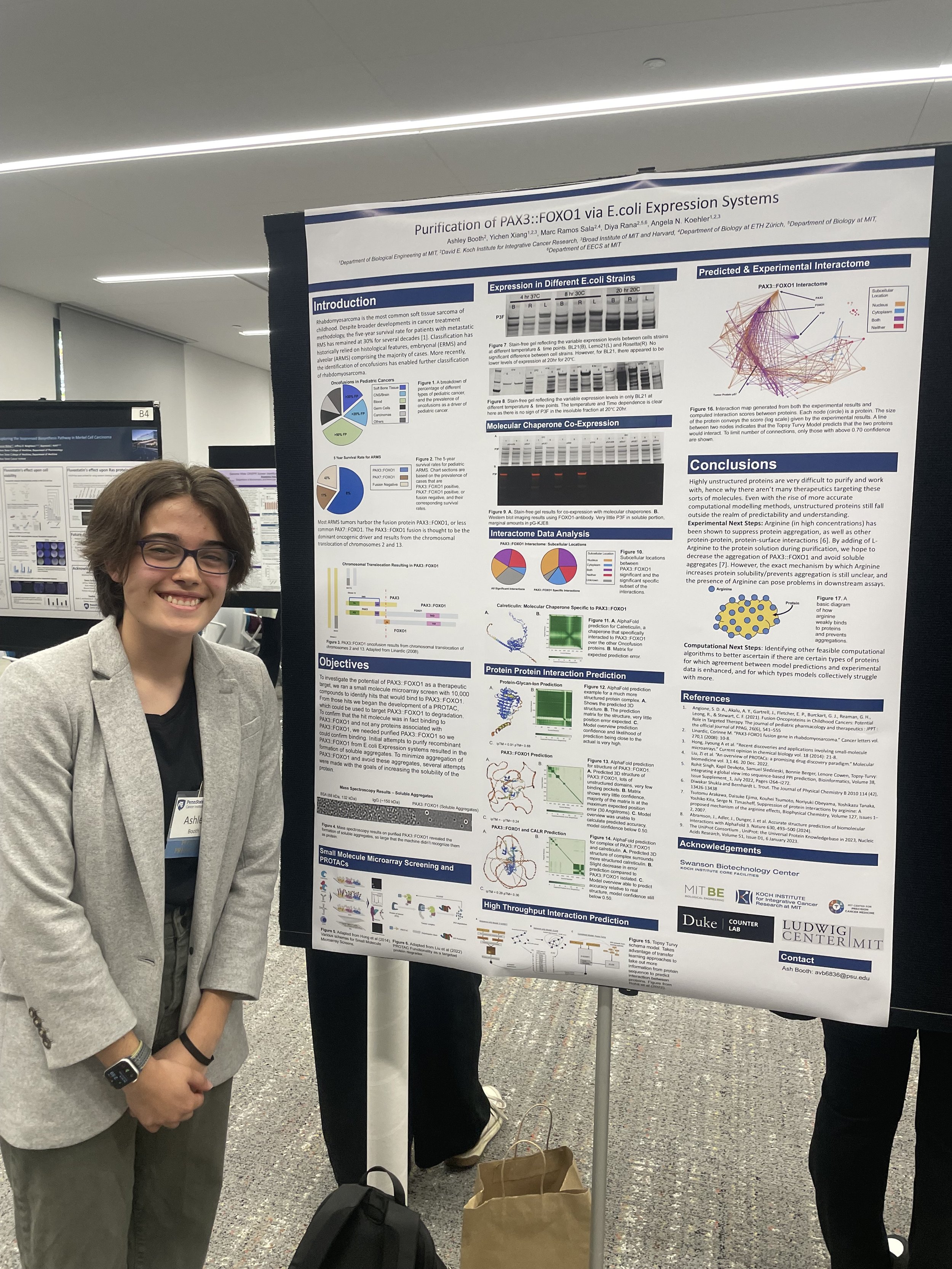
We had the pleasure of hosting Ashley Booth as an undergraduate researcher from Penn State over the summer. Ash’s work focused on computational and biochemical approached to study the PAX3::FOXO1 fusion in pediatric alveolar rhabdomyosarcoma. Here is a picture of Ash presenting the work at a Cancer Research Day Symposium!
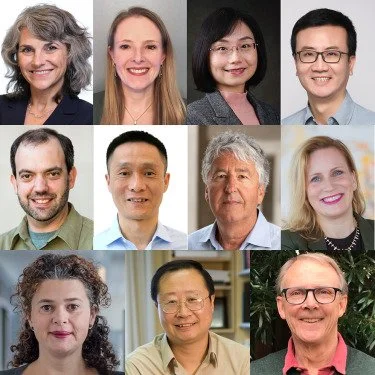
In honor of Cell Chemical Biology’s 30th anniversary, read various perspectives from chemical biologists on how the journal and the field have grown since my time as a graduate student (in the September issue). In our lab, we like to say the journal publishes chemical biology with a capital C and a capital B. Click the Photo below to access the perspectives from Michelle Arkin (UCSF), Sara Buhrlage (Harvard Medical School). Ling-Ling Chen (Shanghai Institutes for Biological Sciences), Peng Chen (Peking University), Jason Gestwicki (UCSF), Chuan He (U. Chicago), Gerald Joyce (The Salk Institute), Milka Kostic (Dana-Farber Cancer Institute), Jun Liu (Johns Hopkins School of Medicine), Jim Wells (UCSF), and yours truly here at MIT.
It was a pleasure to meet with Yutaka Fukunaga, Director of Research and Development, from TAKII Seed about our collaboration to make healthy plants. Thank you to Shinsuke for the kind introduction and we look forward to our work together!

Congratulations to Yichen for another fellowship. The Takeda Fellowship was established by Takeda Pharmaceuticals Ltd. in 2020 and provides graduate student support for students conducting research at the intersection of artificial intelligence and health in the MIT School of Engineering. Yichen’s project focuses on impacting pediatric drug discovery, a vastly underfunded area of research.
The Koehler Lab aims to innovate in the earliest stages of drug discovery by building chemical tools or technologies to assist in the process of target validation and by expanding the repertoire of protein targets that are considered to be druggable. We focus primarily on building chemical tools and methods for studying temporal aspects of transcriptional regulation in development and disease with a focus on cancer.
The Koehler Lab is supported through the generosity of our public and private funding partners.
We will gladly accommodate requests for greater accessibility of public content.