
Histone deacetylases (HDACs) have emerged as valuable targets for small-molecule probes and drugs due to their fundamental role in transcriptional regulation and implication in several diseases. Much effort has been placed on structure-aided design for inhibitors of the HDAC active site, though limited progress has been made towards developing inhibitors selective for individual isoforms. High-throughput and unbiased screens to discover novel molecular scaffolds will be critical for developing a collection of isoform-selective small molecules, which would enable investigators to probe the function of individual isoforms in different cellular and medical contexts.
Our group has an interest in elucidating the relevant cellular functions and substrates for various Class IIa HDACs with an emphasis on non-histone substrates, including transcription factors. Our group combines direct binding assays with biochemical and cellular assays to identify HDAC modulators with novel chemical structures, selectivity patterns, or mechanisms of action unrelated to deacetylase activity. To learn more about our endeavors in this space, please see the HDAC entries in our probes section.
Protein kinases are master regulators of cellular signaling and transcriptional control, making them among the most successful drug targets, with around 100 FDA-approved therapeutics. Yet, despite their clinical impact, much of the human kinome remains unexplored. We leverage unbiased chemical biology and high-throughput discovery platforms to identify novel kinase-targeting scaffolds that can selectively perturb transcriptional programs and reveal the functions of individual kinase isoforms and disease-associated variants in physiologically relevant cellular contexts.
Our work has demonstrated the potential of this approach in prostate cancer. Through SMM screening, we discovered KI-ARv-03, a small molecule that disrupts androgen receptor variant-driven transcription and suppresses cancer cell proliferation. Subsequent optimization led to KB-0742, a potent, orally bioavailable, and selective CDK9 inhibitor that significantly reduced tumor growth in preclinical models of castration-resistant prostate cancer. These studies illustrate how targeting kinase-dependent transcriptional networks can provide effective strategies for modulating oncogenic transcription and expanding the landscape of tractable therapeutic targets.

Structures of novel deacetylase inhibitors with varying selectivity patterns
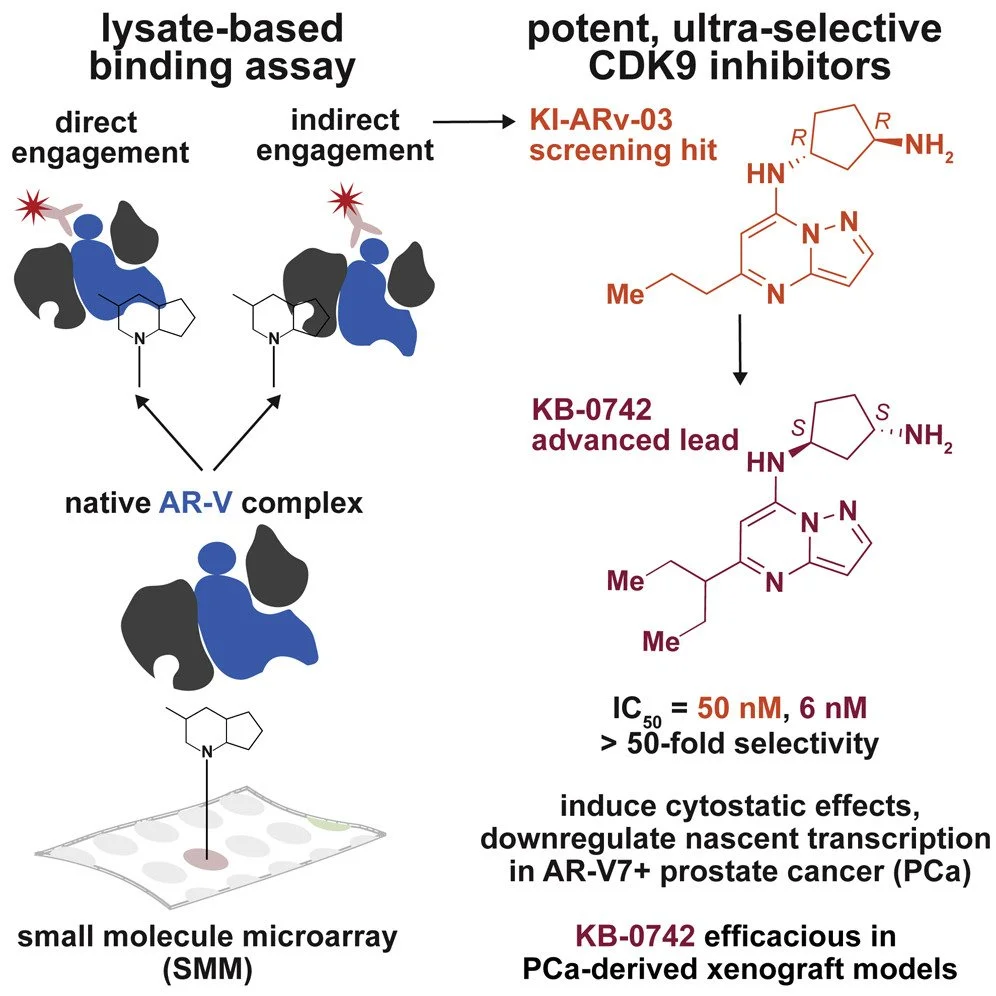
Modulating Androgen Receptor-driven transcription in prostate cancer with selective CDK9 inhibitors. Cell Chemical Biology, 28, 134-147, 2021.